Quick Answer
Beef protein isolate is not automatically a complete protein just because the label says “beef.” It qualifies as complete only when the finished ingredient provides all nine essential amino acids in adequate amounts. Some products are made from collagen-rich bovine tissues and may contain little or no tryptophan, with lower leucine and total essential amino-acid density. Verify the source, full amino-acid profile and serving-level data.
For consumers, the practical question is whether the product delivers a balanced essential amino-acid profile for its intended use. For supplement brands, the correct decision requires a specification, recent lot COA, amino-acid test report and manufacturing flowchart—not a front-label claim alone.
What Is Beef Protein Isolate?
Beef protein isolate is a concentrated or hydrolyzed bovine protein ingredient used in powders, ready-to-mix products, bars and other nutrition formulas. The commercial name can cover ingredients made from different bovine raw materials and processes. Depending on the supplier, the starting material may be muscle-rich tissue, connective tissue, hide-derived protein, gelatin- or collagen-rich fractions, or a blend of bovine proteins.
This source variation matters. A muscle-rich protein and a collagen-rich hydrolysate can both report a high total protein percentage while having very different levels of tryptophan, leucine and other essential amino acids. Brands evaluating a bulk ingredient should review the actual beef protein isolate specification together with a complete amino-acid report.
What Does “Complete Protein” Mean?
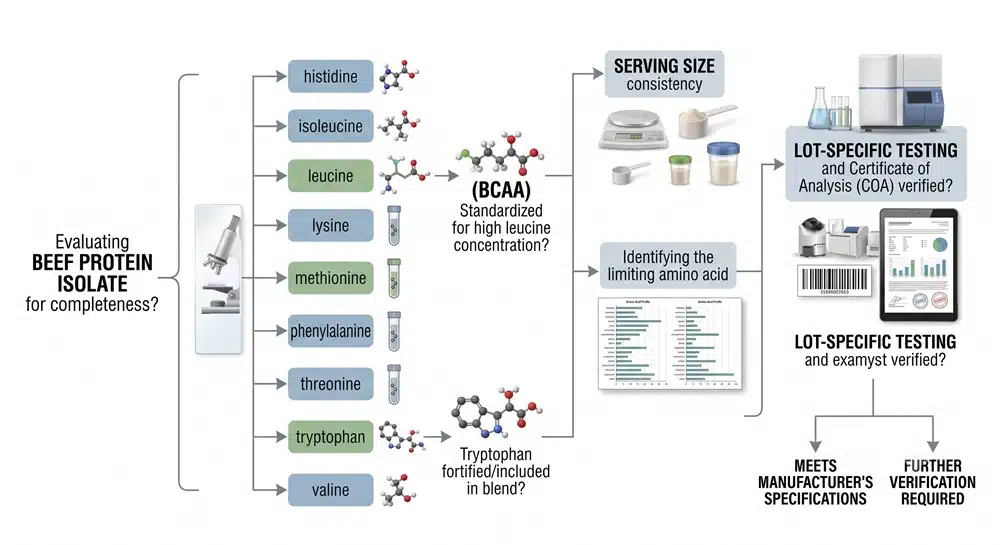
A complete protein supplies all nine essential amino acids: histidine, isoleucine, leucine, lysine, methionine, phenylalanine, threonine, tryptophan and valine. However, simply detecting all nine is not the whole quality assessment. Their amounts, the serving size, the limiting amino acid and digestibility also affect how useful the protein is for a particular nutrition goal.
| Verification Question | Why It Matters | Document or Test to Request |
|---|---|---|
| Are all nine essential amino acids measured? | A product cannot support a complete-protein claim if an essential amino acid is absent or not tested. | Full amino-acid chromatogram or accredited laboratory report, including tryptophan. |
| Are the amounts adequate, not merely detectable? | Trace presence does not establish a balanced or high-quality protein. | Results expressed per 100 g protein and per proposed serving. |
| What is the limiting amino acid? | The lowest indispensable amino acid relative to a reference pattern constrains protein quality. | Amino-acid score or qualified protein-quality assessment. |
| How was total protein measured? | Total nitrogen-based protein results do not show the distribution of essential amino acids. | Protein assay method, conversion factor and dry-basis/as-is basis. |
| Was the finished product verified? | Flavor systems, other proteins and processing can change the final serving composition. | Finished-product protein and, when material to the claim, amino-acid verification. |
Is Beef Protein Isolate a Complete Protein?
The most accurate answer is: sometimes, but the product must prove it. A bovine protein ingredient with a balanced amino-acid profile, measurable tryptophan and adequate essential amino acids can qualify as complete. A collagen-dominant ingredient typically cannot, because conventional bovine collagen lacks tryptophan and is relatively low in several indispensable amino acids.
Do not use tissue-source language alone as proof. “Muscle-derived,” “whole-beef,” “hydrolyzed beef,” “grass-fed” and “beef isolate” are sourcing or marketing descriptions, not substitutes for analytical results. The same applies to a high protein percentage: a 90% protein result does not by itself establish leucine density, tryptophan content or protein quality.
Beef Protein Isolate Amino Acid Profile: What to Check
GSC data shows strong demand for “beef protein isolate amino acid profile,” “leucine content” and “per 100 g” searches. The safest approach is not to publish one universal profile. Amino-acid composition varies by source material, hydrolysis, filtration and lot. Request values from the exact ingredient that will be used.
| Profile Signal | More Balanced Sports-Protein Pattern | Collagen-Rich Pattern | Interpretation |
|---|---|---|---|
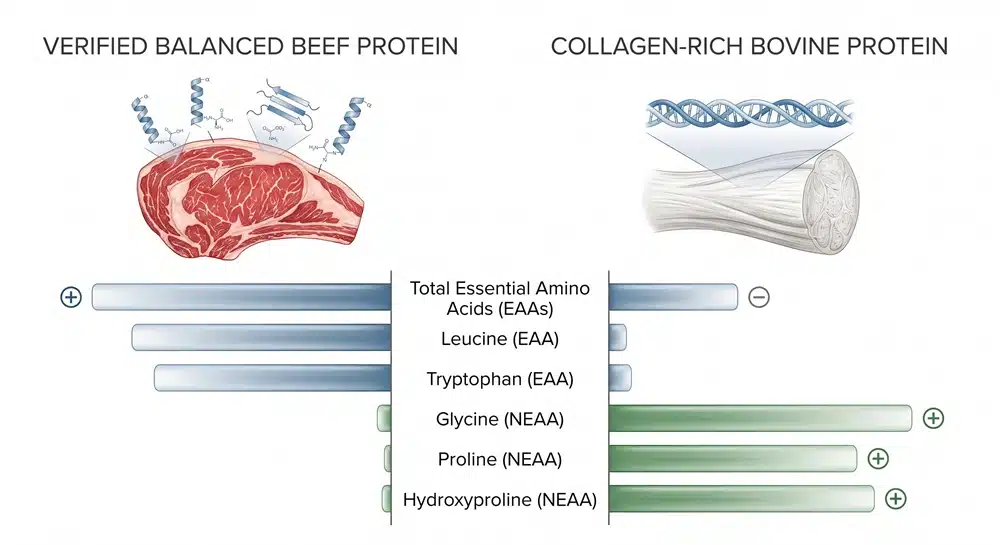
| Tryptophan | Measured at a meaningful level | Absent, not reported or only trace | A conventional collagen-dominant profile is incomplete without tryptophan. |
| Leucine and total EAAs | Material contribution per serving | Lower EAA density relative to total protein | Important for performance positioning; no universal beef-isolate number should be assumed. |
| Glycine, proline and hydroxyproline | Present but not overwhelmingly dominant | Often major components | A strong collagen signature suggests connective-tissue-derived protein. |
| Serving-level disclosure | Protein, EAAs and leucine can be calculated from the serving | Only total protein is emphasized | Per-serving data is more useful than a powder-level percentage alone. |
| Laboratory method | Method and basis are identified | Undisclosed “typical values” | Tryptophan often requires a different analytical preparation from other amino acids. |
There is no reliable visual or taste test that can determine whether a powder is complete. The decision should come from analytical documentation, not from color, solubility, molecular-weight claims or the word “isolate.”
How Is Beef Protein Isolate Made?
Manufacturing processes vary, but a typical commercial flow may include the following stages. Brands should request a supplier flowchart because the raw material and processing choices directly affect the amino-acid profile and finished-product positioning.
| Stage | Typical Purpose | Buyer Verification Point |
|---|---|---|
| 1. Raw-material selection | Select bovine tissue or protein fraction. | Species, tissue type, country of origin, traceability, veterinary and BSE/TSE documentation where applicable. |
| 2. Cleaning and extraction | Remove non-protein material and transfer protein into a processable phase. | Processing aids, temperature controls and allergen/cross-contact program. |
| 3. Hydrolysis | Use enzymes, heat or controlled conditions to produce smaller peptides. | Enzyme source, degree of hydrolysis, peptide distribution and flavor impact. |
| 4. Separation and purification | Reduce fat, insoluble material, salts or other non-protein components. | Filtration method, sodium, ash, fat and carbohydrate specifications. |
| 5. Concentration and drying | Produce a stable powder, commonly by spray drying. | Moisture, bulk density, particle size, solubility and heat history. |
| 6. Lot testing and release | Verify the ingredient against approved specifications. | Identity, protein, amino acids, microbiology, heavy metals, melamine, sensory and relevant contaminants. |
Hydrolysis can change peptide size and functional properties, but “hydrolyzed” does not automatically mean superior absorption, better muscle outcomes or a complete amino-acid profile. Those conclusions require product-specific evidence.
Beef Protein Isolate vs Collagen: Are They the Same?
No. They can share a bovine origin, and a beef protein ingredient can contain collagen-associated amino acids, but they should not be treated as nutritionally identical.
| Factor | Verified Complete Beef Protein | Collagen Peptides / Gelatin-Dominant Protein |
|---|---|---|
| Primary quality question | Does it provide adequate essential amino acids per serving? | Is it intentionally positioned as a collagen peptide ingredient? |
| Tryptophan | Should be measured and present in an adequate profile | Conventionally absent or extremely low |
| Typical amino-acid emphasis | Broader EAA distribution | Glycine, proline and hydroxyproline |
| Best-supported positioning | General protein or sports formula only when profile and serving support it | Collagen-specific formula with evidence appropriate to the exact ingredient and dose |
| Label risk | Calling it complete without a full profile | Presenting collagen as equivalent to a balanced dietary protein |
For a broader dairy-free performance comparison, see the beef protein isolate vs whey formulation guide. This page should remain focused on completeness, collagen differentiation and verification rather than duplicating the full whey comparison.
Can Beef Protein Isolate Support Muscle and Recovery?
Protein supplementation can help people meet protein needs, and limited studies have evaluated beef-protein supplements during resistance training. However, the evidence does not establish that every product sold as beef protein isolate is equivalent to whey, whole beef or another high-quality protein. Outcomes depend on the actual amino-acid profile, serving size, total diet, training program and study product.
Brands should avoid universal claims such as “builds more muscle,” “absorbs faster,” “better than whey” or “clinically proven for recovery” unless the marketed finished product, dose and population are directly supported. A compliant general statement should stay close to the product’s measured composition and intended role in helping users meet dietary protein intake.
Beef Protein Isolate Safety and Side Effects
Safety and tolerance depend on the ingredient, amount, flavor system, co-ingredients and individual health status. Beef protein isolate should not be described as universally hypoallergenic or side-effect-free.
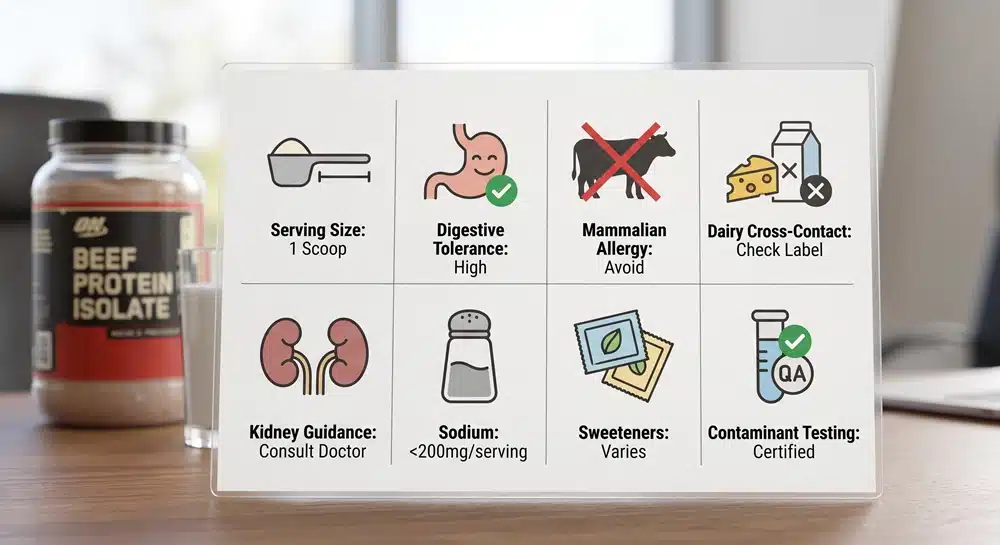
- Digestive tolerance: Large servings, hydrolysate bitterness, sweeteners, gums or other formula components may contribute to nausea, bloating or gastrointestinal discomfort.
- Beef or mammalian-product allergy: People with a known beef allergy or other medically diagnosed reaction to mammalian products should obtain individualized medical guidance.
- Dairy-free is not allergen-free: Verify shared-equipment controls and finished-product testing before making dairy-free or milk-allergen claims.
- Kidney or metabolic conditions: People managing kidney disease or medically restricted protein intake should follow advice from a qualified healthcare professional.
- Sodium and processing residues: Review sodium, ash, processing aids and the complete finished-product label rather than assuming all isolates are identical.
- Contaminants and microbiology: Establish product-specific limits for heavy metals, pathogens and other relevant contaminants under the applicable quality system.
Consumers who experience persistent symptoms should stop using the product and seek qualified medical advice. This article is educational and does not diagnose, treat or prevent disease.
How Supplement Brands Should Verify Beef Protein Isolate
Brands developing dairy-free protein powders should combine ingredient verification with qualified supplement quality control. A supplier COA is useful, but it should be reviewed against an approved specification and supported by identity and finished-product controls.
| Specification Area | Minimum Review | Why It Matters |
|---|---|---|
| Identity and source | Bovine species, tissue/fraction, origin, process flow and traceability | Defines what the ingredient actually is and supports label positioning. |
| Protein assay | Method, nitrogen conversion factor, dry-basis and as-is result | Prevents misleading comparisons between incompatible test bases. |
| Complete amino-acid profile | All nine EAAs, tryptophan method, leucine, glycine, proline and hydroxyproline | Determines whether a complete-protein or sports-protein claim is supportable. |
| Functional properties | Solubility, dispersibility, bulk density, particle size, flavor and degree of hydrolysis | Influences serving size, mouthfeel, flavor masking and processing. |
| Contaminants | Heavy metals, microbiology, melamine and risk-based additional tests | Supports ingredient and finished-product safety specifications. |
| Market documents | Allergen statement, BSE/TSE, animal-origin statement, halal/kosher certificates if claimed | Supports target-market review and prevents unsupported lifestyle claims. |
| Stability | Packaging, storage, shelf-life basis and finished-product stability plan | Confirms quality through the labeled shelf life. |
Buyer Checklist
- Do not approve a “complete protein” claim without a full amino-acid report that includes tryptophan.
- Calculate essential amino acids and leucine per proposed serving, not only per 100 g powder.
- Confirm whether the source is muscle-rich, collagen-rich or blended.
- Match the protein assay method and basis across supplier comparisons.
- Review glycine, proline and hydroxyproline as indicators of collagen contribution.
- Verify dairy-free, allergen, halal, kosher, grass-fed and origin claims with documentation.
- Run pilot work for solubility, foam, bitterness, color and flavor masking.
- Set finished-product specifications for protein, composition, contaminants and sensory quality.
- Review all muscle, recovery, absorption and safety copy under FDA and FTC claim standards.
RFP Questions for a Beef Protein Isolate Supplier or Manufacturer
- What bovine tissue or protein fraction is used, and is it muscle-rich, connective-tissue-rich or blended?
- Can you provide the current specification, lot COA and complete amino-acid report, including tryptophan?
- What are the leucine and total essential amino-acid values per 100 g protein and per recommended serving?
- Which total-protein method and nitrogen conversion factor are used?
- What hydrolysis, filtration and drying steps are used, and what is the degree of hydrolysis or peptide distribution?
- What identity, microbiology, heavy-metal and melamine methods are used?
- Which BSE/TSE, species, origin and traceability documents are available?
- Can the supplier substantiate dairy-free, allergen, halal, kosher or grass-fed claims?
- What are the solubility, bulk density, particle-size and flavor characteristics?
- What packaging, storage, MOQ, sample, lead-time and shelf-life conditions apply?
- Can the manufacturer verify the protein and composition of the finished flavored product?
- What change-control notification is provided if the raw material, tissue source or process changes?
For COA review, samples, bulk sourcing or custom protein formulation, contact GENSEI with the target market, serving size, amino-acid requirements, quantity and documentation needs.
Frequently Asked Questions
Is beef isolate a complete protein?
It can be, but the name alone is not proof. Confirm all nine essential amino acids, including tryptophan, and assess whether their amounts are adequate for the serving and intended claim.
What is beef protein isolate made from?
Commercial ingredients may be produced from different bovine tissues or protein fractions, including muscle-rich and connective-tissue-rich materials. Request the supplier’s raw-material statement and manufacturing flowchart.
How is beef protein isolate made?
Typical processing may include raw-material preparation, extraction, hydrolysis, separation, concentration, drying and lot testing. The exact steps vary by supplier and should be documented.
Does beef protein isolate contain collagen?
It may contain collagen-derived peptides, especially when connective tissue is used. Review glycine, proline, hydroxyproline, tryptophan and total EAA results to understand the protein profile.
Is beef protein isolate safe?
No protein ingredient is universally safe for everyone. Safety depends on ingredient identity, contaminants, serving size, co-ingredients and personal health factors. People with relevant allergies, kidney disease or medically restricted diets should seek professional advice.
Is beef protein isolate vegetarian?
No. It is derived from cattle and is not vegetarian or vegan. Halal and kosher status also require valid certification rather than assumptions based on species alone.
Is beef protein isolate better than collagen?
They serve different formulation roles. A verified complete beef protein can be positioned as a general dietary protein, while collagen is a specialized peptide ingredient with a distinct amino-acid profile. Neither is automatically “better” without defining the intended use.
Is beef protein isolate better than whey?
Not universally. Whey generally has stronger research support and a high EAA and leucine profile, while beef protein may suit dairy-free positioning. Compare actual serving-level amino acids, tolerance, flavor, cost and evidence.
Final Takeaway
Beef protein isolate should be called a complete protein only when the exact ingredient and serving demonstrate all nine essential amino acids in adequate amounts. Because commercial products can range from balanced bovine proteins to collagen-rich hydrolysates, the reliable decision comes from tryptophan, leucine, total EAA, source and finished-product data—not from the word “beef,” “isolate,” “hydrolyzed” or a high protein percentage.
References
- U.S. FDA — Interactive Nutrition Facts Label: Protein
- FAO — Dietary Protein Quality Evaluation in Human Nutrition
- Paul et al. — Collagen Peptides and Indispensable Amino Acid Balance
- Valenzuela et al. — Beef Protein Supplementation Systematic Review
- Sharp et al. — Beef Protein Isolate and Whey Protein Isolate During Resistance Training
- Gorissen et al. — Protein Content and Amino Acid Composition of Commercial Protein Isolates
- U.S. FDA — Dietary Supplement Current Good Manufacturing Practice Guide
- U.S. FDA — Dietary Supplement Labeling Guide, Nutrition Labeling
- U.S. FDA — Structure/Function Claims
- U.S. FTC — Health Products Compliance Guidance

Warren Wan is a seasoned expert with extensive experience in the dietary supplement supply chain, possessing rich practical experience in the research, development, process control, and global sourcing of core ingredients such as collagen peptides, bone broth protein, and keratin. As the author of this column, he is dedicated to stripping away the marketing packaging, transforming obscure ingredient science and production quality control standards into easy-to-understand, hardcore science popularization, helping readers understand the truth behind the labels and make more rational health choices.