
This guide is for food, beverage and supplement formulators, procurement teams and brands. Choose polydextrose when the main target is fiber-compatible bulk or reduced-calorie texture; choose dextrose monohydrate when the formula needs digestible glucose, sweetness, fermentation or reducing-sugar functionality. Neither ingredient should be marketed as a treatment for diabetes, hypoglycemia, weight loss or digestive disease.
Procurement teams can use the comparison, specification and RFP sections below together with GENSEI’s specialty supplement ingredients hub.
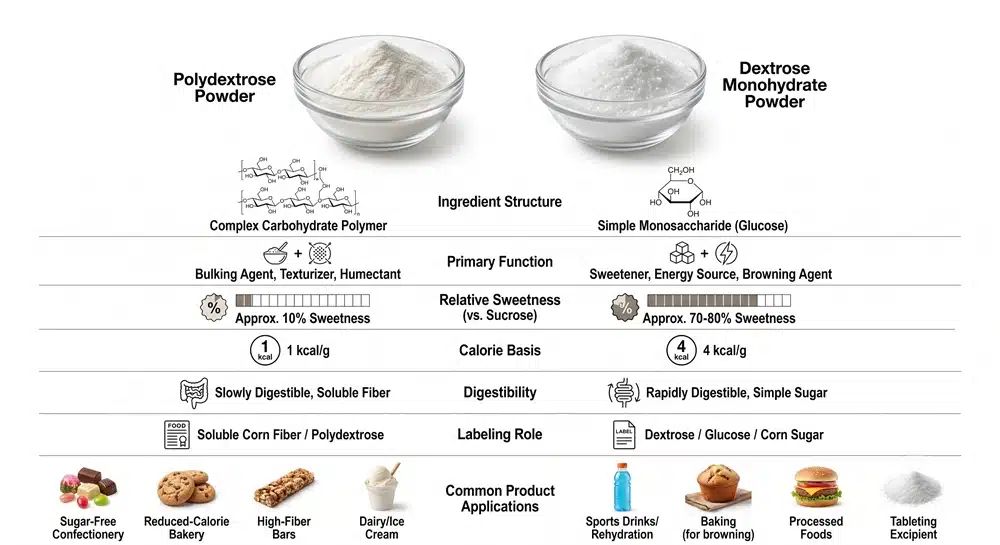
Polydextrose vs Dextrose Monohydrate at a Glance
| Factor | Polydextrose | Dextrose Monohydrate |
|---|---|---|
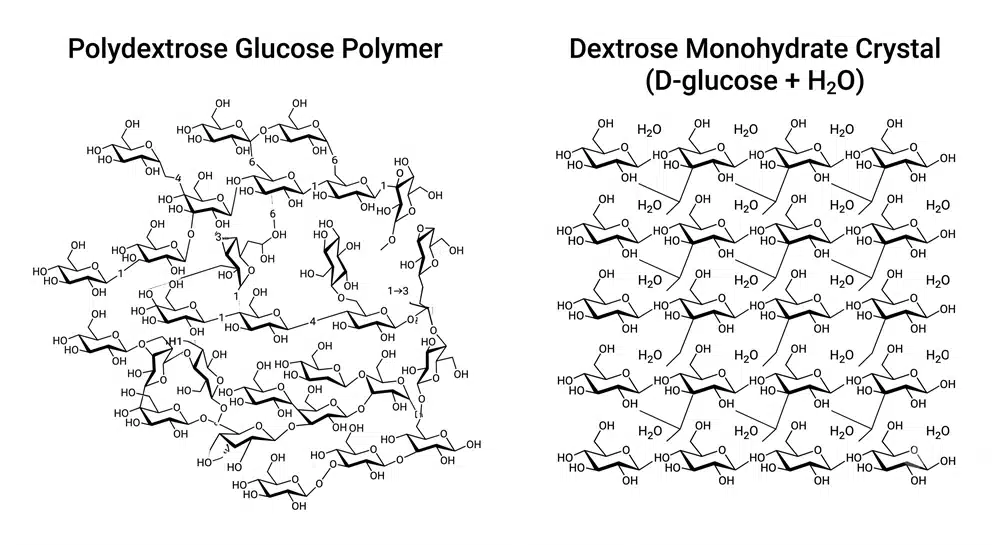
| Ingredient type | Randomly bonded glucose polymer containing small amounts of sorbitol and acid residues | D-glucose crystal containing one molecule of water |
| Primary function | Bulking, texturizing, humectancy, calorie reduction and dietary-fiber formulation | Nutritive sweetening, fermentable carbohydrate, browning, carrier and rapid carbohydrate delivery |
| Typical energy basis | FDA currently permits 1 kcal/g for U.S. label calculations under its stated enforcement policy | About 90.9% anhydrous glucose solids by molecular weight; an ideal pure monohydrate is approximately 3.6 kcal/g on that basis |
| Sweetness | Low sweetness; usually needs a separate sweetener system | Sweet, but generally less sweet than sucrose |
| Digestibility | Not fully digested in the small intestine and partly fermented in the colon | Readily digested and absorbed as glucose |
| U.S. dietary-fiber labeling | May be included in declared dietary fiber under current FDA guidance and enforcement discretion when requirements are met | Not dietary fiber |
| Primary tolerance issue | Higher servings can cause gas, bloating, abdominal discomfort or loose stools in some people | Serving size adds rapidly available carbohydrate and total sugars |
| Common applications | Fiber gummies, bars, reduced-sugar foods, beverages, powders and confectionery | Sports powders, drink mixes, bakery, fermentation, tablets, carriers and functional foods |
What Is Polydextrose?
Polydextrose is produced by controlled polymerization of glucose with sorbitol and an acid catalyst. Its random linkages are not readily hydrolyzed by human digestive enzymes in the small intestine. Part of the ingredient reaches the colon, where it can be fermented by intestinal microorganisms.
In food systems, polydextrose functions primarily as a bulking agent, formulation aid, humectant and texturizer. It can replace part of the solids lost when sugar or fat is reduced, but it does not reproduce all of sucrose’s sweetness, crystallization, preservation or browning functions.
What Is Dextrose Monohydrate?
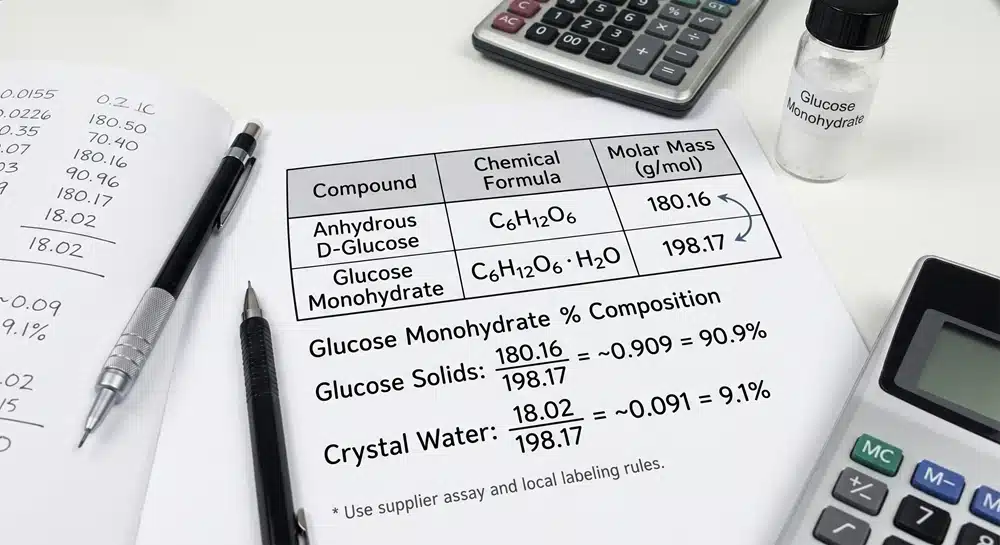
Dextrose monohydrate is the monohydrate form of D-glucose. Each crystal contains glucose plus one molecule of water. The molecular weight of glucose monohydrate is approximately 198.17 g/mol, compared with approximately 180.16 g/mol for anhydrous D-glucose.
This means ideal dextrose monohydrate is approximately 90.9% glucose solids and 9.1% crystal water by molecular weight. Formulators should still use the supplier’s assay, moisture and dry-solids specification rather than relying only on theoretical values.
Is Polydextrose Sugar?
Polydextrose is made mainly from glucose, but it is not nutritionally or functionally equivalent to ordinary sugar. Its glucose units are connected through a highly branched, random polymer structure that resists normal small-intestinal digestion.
Ingredient-list terminology and Nutrition or Supplement Facts calculations are separate issues. Brands must determine how the ingredient contributes to total carbohydrate, dietary fiber, calories, total sugars and added sugars under the rules of each destination market.
Polydextrose vs Dextrose: Key Functional Differences
1. Calories and Nutritional Role
Polydextrose is used when a formula needs solids and body with fewer calories than digestible carbohydrate. For U.S. labeling, FDA currently states that manufacturers may use 1 kcal/g for polydextrose under its published enforcement policy.
Dextrose monohydrate supplies digestible glucose. Because the monohydrate contains crystal water, it provides less glucose solids per gram than anhydrous dextrose. Do not use a universal calorie figure without confirming ingredient form, purity, solids and local labeling rules.
2. Sweetness
Polydextrose has little sweetness and is not a one-for-one replacement for sucrose or dextrose. Reduced-sugar products usually require a separate sweetness system, which may include high-intensity sweeteners, polyols, rare sugars or other carbohydrates.
Dextrose contributes sweetness but is generally less sweet than sucrose. It can also affect water activity, freezing point, fermentation, color development and texture.
3. Glycemic and Claim Considerations
Dextrose is glucose and contributes rapidly available carbohydrate. Polydextrose is not fully digested as glucose and normally contributes much less available carbohydrate per gram.
This difference does not justify claims such as “safe for diabetics,” “controls blood sugar” or “treats hypoglycemia.” The complete formula, serving size, total available carbohydrate, target population and permitted claim language must be reviewed.
4. Digestive Tolerance
Polydextrose can contribute to fiber intake and may support normal bowel function when used appropriately. Tolerance depends on dose, serving pattern, other fermentable ingredients and individual sensitivity. A gradual serving strategy may be useful in products providing meaningful amounts.
Dextrose does not provide dietary fiber. Its main nutrition consideration is the amount of digestible carbohydrate and sugar delivered per serving.
5. Texture and Processing
Polydextrose can add bulk, body and mouthfeel to reduced-sugar or reduced-fat systems. It can also influence viscosity, glass transition, moisture management and texture. It does not automatically replace every technical function of sugar.
Dextrose is a reducing sugar. It can support fermentation and browning reactions, but it may also react with amino-containing ingredients during processing or storage. Formulators should review heat exposure, moisture, flavor, color and shelf-life stability.
Which Ingredient Is Better for Each Product?
| Product Goal | Likely Starting Ingredient | Development Questions |
|---|---|---|
| Increase declared dietary fiber | Polydextrose | Fiber eligibility, dose, tolerance, calorie calculation and destination-market labeling |
| Reduce sugar while maintaining bulk | Polydextrose plus a separate sweetener system | Sweetness, water activity, texture, browning, preservation and shelf life |
| Provide digestible carbohydrate | Dextrose monohydrate | Carbohydrate grams, osmolality, flavor, serving size and intended use |
| Sports drink or recovery powder | Dextrose monohydrate or a carbohydrate blend | Dissolution, osmolality, serving size, flavor and gastrointestinal tolerance |
| Fiber gummy | Polydextrose, often with other fibers | Cook stability, water activity, texture, fiber dose, sweetness and tolerance |
| Tablet carrier or binder | Dextrose monohydrate in selected systems | Reducing-sugar compatibility, moisture, flow, compactability and assay basis |
| Low-sugar bar or confectionery | Polydextrose as part of a multi-ingredient system | Binding, hardness, moisture migration, sweetness and sensory stability |
Can Polydextrose Replace Dextrose One-to-One?
No. The ingredients differ in sweetness, digestibility, solids, water binding, fermentation, browning and nutritional labeling. A one-to-one replacement can change taste, texture, moisture, color, calorie values and shelf life.
Reformulation should begin with the functional target: replace sweetness, replace bulk, add fiber, reduce calories, control water activity, support fermentation or provide carbohydrate. Each target may require a different combination of ingredients.
Dextrose Monohydrate vs Anhydrous Dextrose
Dextrose monohydrate includes one molecule of crystal water; anhydrous dextrose does not. On a theoretical molecular-weight basis, 100 kg of pure dextrose monohydrate contains approximately 90.9 kg of anhydrous glucose equivalent and approximately 9.1 kg of crystal water.
Do not substitute the forms solely by equal weight. Recalculate glucose solids, water contribution, sweetness, solids concentration and process behavior. The supplier specification should identify monohydrate or anhydrous form, assay basis, moisture, particle size and intended grade.
Safety and Labeling Considerations
Polydextrose
- Increase serving amounts cautiously when the finished product provides a meaningful fermentable-fiber dose.
- Use accurate tolerance language; do not promise digestive benefits for every consumer.
- Verify dietary-fiber eligibility and calorie calculations in each target market.
- Do not describe isolated polydextrose as nutritionally identical to whole-food fiber.
- Do not position the product as a diabetes treatment or guaranteed weight-management solution.
Dextrose Monohydrate
- Calculate total carbohydrate, total sugars and added sugars as required by the destination market.
- Review the complete serving size in sports, hydration and energy-positioned products.
- Do not market ordinary foods or supplements as treatments for low blood sugar.
- Review reducing-sugar compatibility with amino acids, proteins and other reactive ingredients.
- Confirm monohydrate versus anhydrous form before performing solids or calorie calculations.
Quality Specification Checklist
| Specification | Polydextrose | Dextrose Monohydrate |
|---|---|---|
| Identity | Validated polymer identity and composition | Validated D-glucose monohydrate identity |
| Assay / solids | Polydextrose content, glucose and sorbitol limits, dry-solids basis | Dextrose assay, dry-solids basis and crystal-water specification |
| Functional profile | Solubility, viscosity and molecular-weight profile where relevant | Reducing-sugar value, solubility and application-specific performance |
| Moisture | Loss on drying or water content | Crystal water, free moisture and caking control |
| Physical properties | Particle size, bulk density, flowability, color and clarity | Particle size, bulk density, flowability, color and solution clarity |
| Contaminants | Heavy metals, microbiology and process-specific residues | Heavy metals, microbiology and starch-source documentation |
| Documentation | Lot COA, specification, TDS/SDS, allergen, GMO and regulatory statements | Lot COA, specification, TDS/SDS, allergen, GMO, origin and grade statements |
| Change control | Notification for source, process, catalyst or specification changes | Notification for starch source, hydrate form, particle size or specification changes |
Raw-material approval should connect specifications, test methods, batch COAs and finished-product release through a documented supplement quality system.
Formulation and Manufacturing Considerations
Powders and Drink Mixes
Dextrose dissolves readily and contributes sweetness and osmolality. Polydextrose can add fiber-compatible solids and body but may increase total solids and digestive load. GENSEI supports powder supplement manufacturing for drink mixes, sachets and functional powder blends.
Gummies and Chewables
Polydextrose can be used in fiber or reduced-sugar systems, but gummy development must validate cook stability, texture, water activity, sweetness, fiber dose and tolerance. Dextrose can influence browning, solids and water activity.
Tablets and Capsules
Dextrose may function as a carrier or excipient in selected tablets, while polydextrose may contribute bulk or fiber. Both require compatibility, flow, compression or fill-volume review. A custom supplement formulation review should confirm the ingredient system before scale-up.
Bars and Functional Foods
Replacing sugar in bars requires control of sweetness, binding, moisture migration, browning and shelf-life texture. Polydextrose may replace part of the bulk, but a multi-ingredient system is usually needed to replace the full functionality of sucrose or glucose syrup.
RFP Questions for Ingredient Suppliers and Manufacturers
- Is the material food grade, supplement grade or compendial grade?
- Which identity, assay, moisture and solids methods are used?
- For polydextrose, what are the polymer, free glucose and sorbitol specifications?
- For dextrose, is the product monohydrate or anhydrous, and what is the dry-solids basis?
- Can you provide three recent lot-specific COAs?
- What are the starch source, country of origin, allergen and GMO statements?
- Which heavy metal, microbiological and process-contaminant tests are included?
- What are the particle size, bulk density, solubility, viscosity and flow characteristics?
- What are the MOQ, sample quantity, packaging and lead time?
- Can you support bench samples and pilot production in the intended dosage form?
- How should dietary fiber, calories, total sugars and added sugars be calculated for the target market?
- What stability, sensory and change-control documentation is available?
Where GENSEI Fits
GENSEI supports specialty ingredient sourcing, custom formulation, powder projects and documentation review for food and dietary supplement applications.
Brands can request a polydextrose or dextrose sample, COA and quotation with the target application, ingredient form, serving size, nutritional target, packaging, destination market and order quantity.
Frequently Asked Questions
Is polydextrose the same as dextrose?
No. Polydextrose is a randomly bonded glucose polymer used mainly for bulk, texture and fiber-compatible formulation. Dextrose is D-glucose used as a nutritive sugar and processing carbohydrate.
Is polydextrose a sugar?
It is produced mainly from glucose, but its polymer structure is not digested like ordinary sugar. U.S. fiber and calorie declarations must follow current FDA policy and the finished-product calculation.
Is polydextrose good or bad?
It can help formulators add fiber-compatible bulk and reduce calories, but higher servings may cause gas, bloating or loose stools in some people. Its value depends on dose, product design and consumer tolerance.
Can polydextrose be used in products marketed to people with diabetes?
A formulator may use it to replace some digestible carbohydrate, but the complete product must be evaluated. Do not claim that polydextrose treats diabetes or makes a product universally suitable for every person with diabetes.
What is the difference between dextrose monohydrate and glucose?
Dextrose is D-glucose. Dextrose monohydrate is a crystalline form containing one molecule of water, which changes weight-based solids and formulation calculations.
What is the difference between dextrose monohydrate and anhydrous dextrose?
The monohydrate contains crystal water; the anhydrous form does not. Changing between them requires recalculation of glucose solids, water contribution and process behavior.
Can polydextrose replace sugar one-to-one?
No. It can replace some bulk and calories, but it does not replace all sweetness, crystallization, browning, preservation and water-activity functions of sugar.
Final Takeaway
Polydextrose and dextrose monohydrate solve different formulation problems. Polydextrose provides low-digestible bulk and can support dietary-fiber formulation. Dextrose monohydrate supplies digestible glucose, sweetness, fermentation and reducing-sugar functionality. The correct choice depends on the label target, sweetness, calorie goal, texture, tolerance, processing conditions and supplier specification—not on a simple “healthy versus unhealthy” comparison.
References
- 21 CFR 172.841: Polydextrose
- FDA: Questions and Answers on Dietary Fiber
- FDA: Declaration of Certain Isolated or Synthetic Non-Digestible Carbohydrates as Dietary Fiber
- PubChem: Glucose Monohydrate
- EFSA: Re-evaluation of Polydextrose (E 1200) as a Food Additive
- Polydextrose: Physiological Function and Effects on Health
- 21 CFR Part 111: Dietary Supplement Current Good Manufacturing Practice
- FTC: Health Products Compliance Guidance

Warren Wan is a seasoned expert with extensive experience in the dietary supplement supply chain, possessing rich practical experience in the research, development, process control, and global sourcing of core ingredients such as collagen peptides, bone broth protein, and keratin. As the author of this column, he is dedicated to stripping away the marketing packaging, transforming obscure ingredient science and production quality control standards into easy-to-understand, hardcore science popularization, helping readers understand the truth behind the labels and make more rational health choices.